What Colors Look Best on Me? 4 Tests to Find the Colors That Suit You
What colors look good on you depends on four things: undertone, depth, chroma and contrast. Four home tests with fabric and daylight, then your season and palette.

In this guide11 sectionsClose
- How to tell if a color suits you
- Set up: light, mirror, fabric
- Test 1: are you warm or cool?
- Test 2: are you light or deep?
- Test 3: are you bright or soft?
- Test 4: what's your contrast?
- Put it together: which season are you?
- See the colors on your own face
- The most common mistakes
- What to do once you know your colors
- FAQ
The colors that look best on you repeat something that's already in your face. If your coloring is warm, light and soft, warm, light and soft colors look like they belong to you. If your coloring is cool, deep and high contrast, so are your best colors. Everything else is a variation on that idea.
So the question "what colors suit me" breaks down into four smaller ones you can answer at home:
- Undertone: warm or cool?
- Depth: light or deep?
- Chroma: bright and clear, or soft and muted?
- Contrast: how different are your hair, skin and eyes?
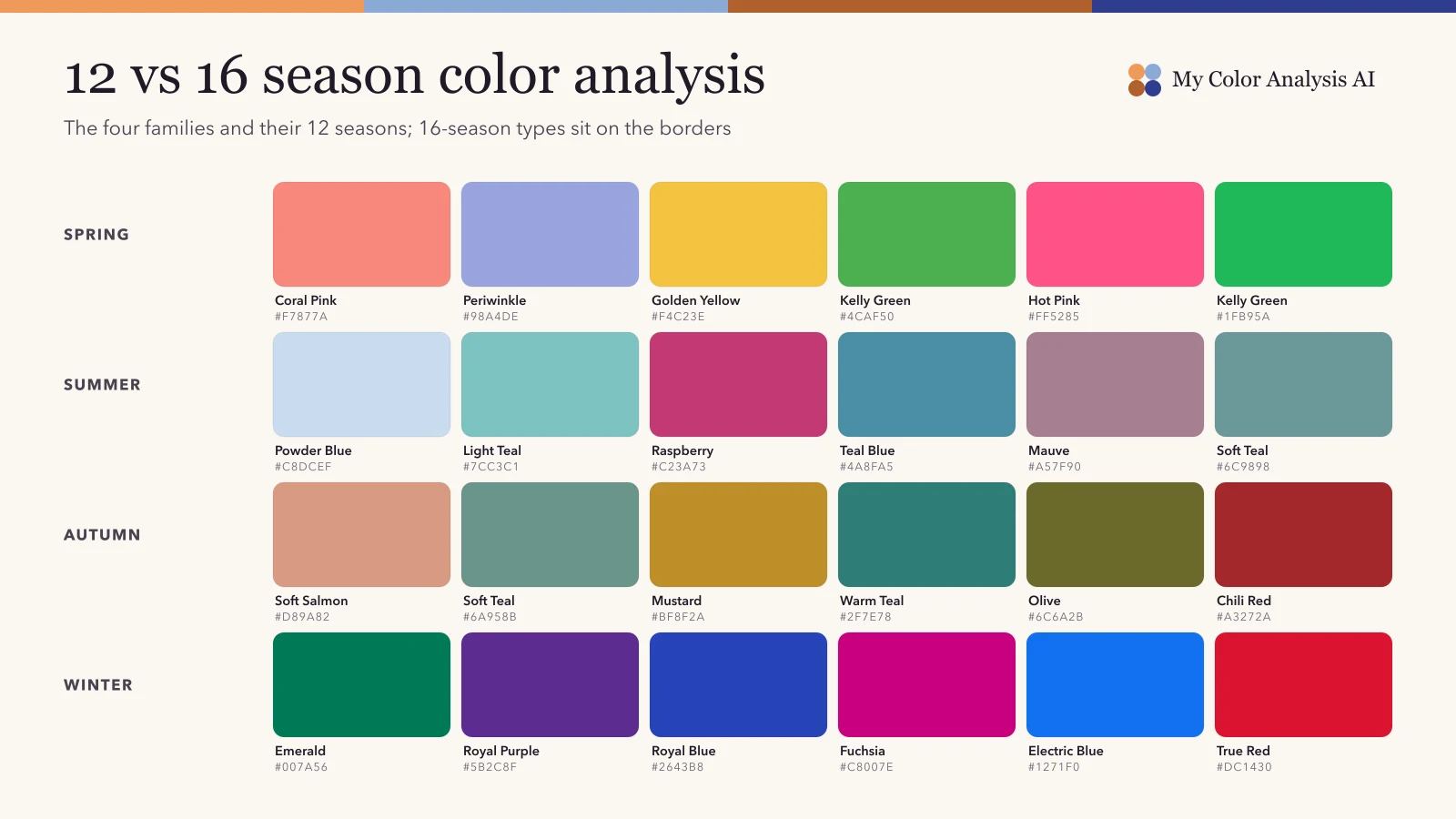
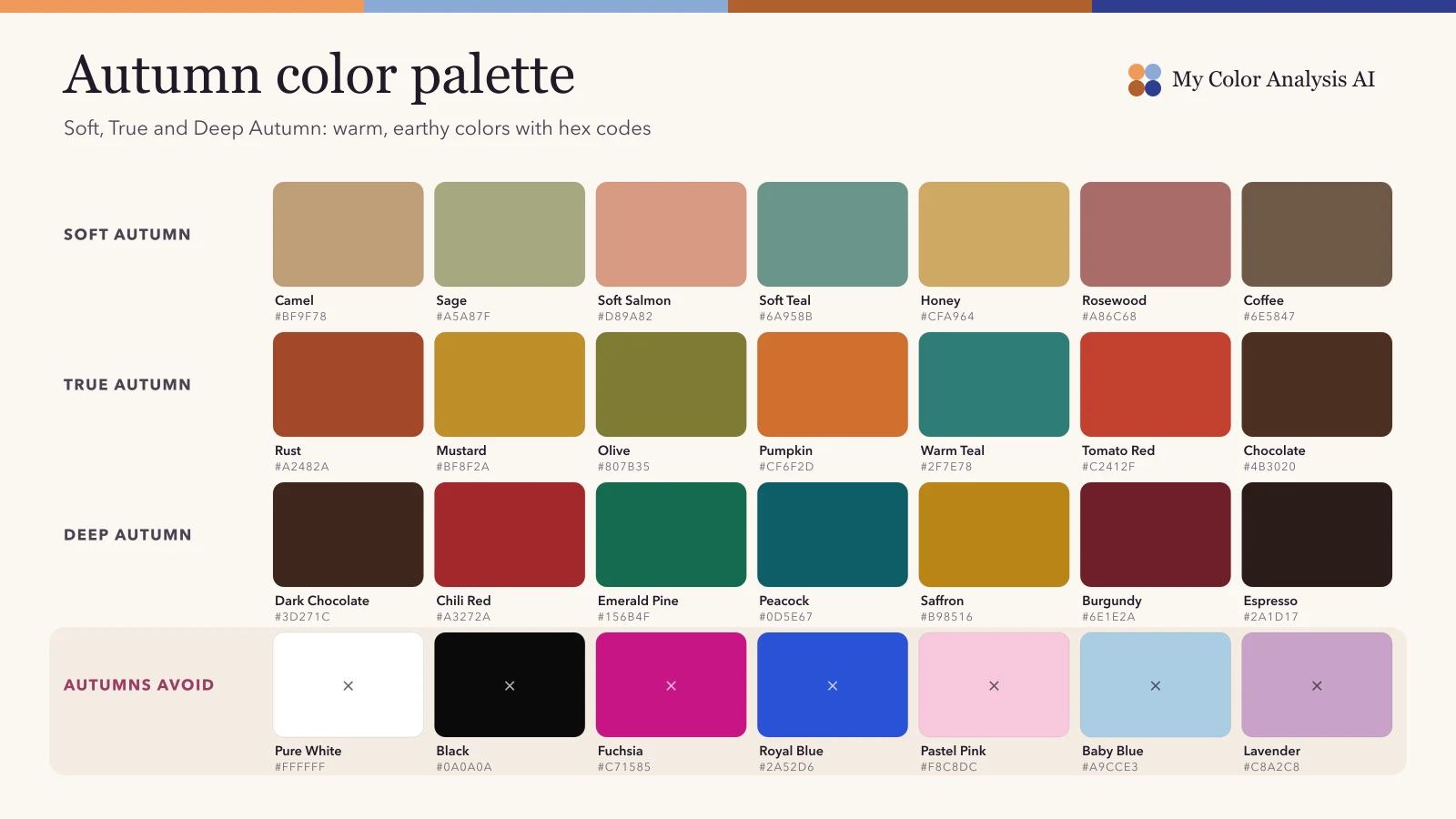
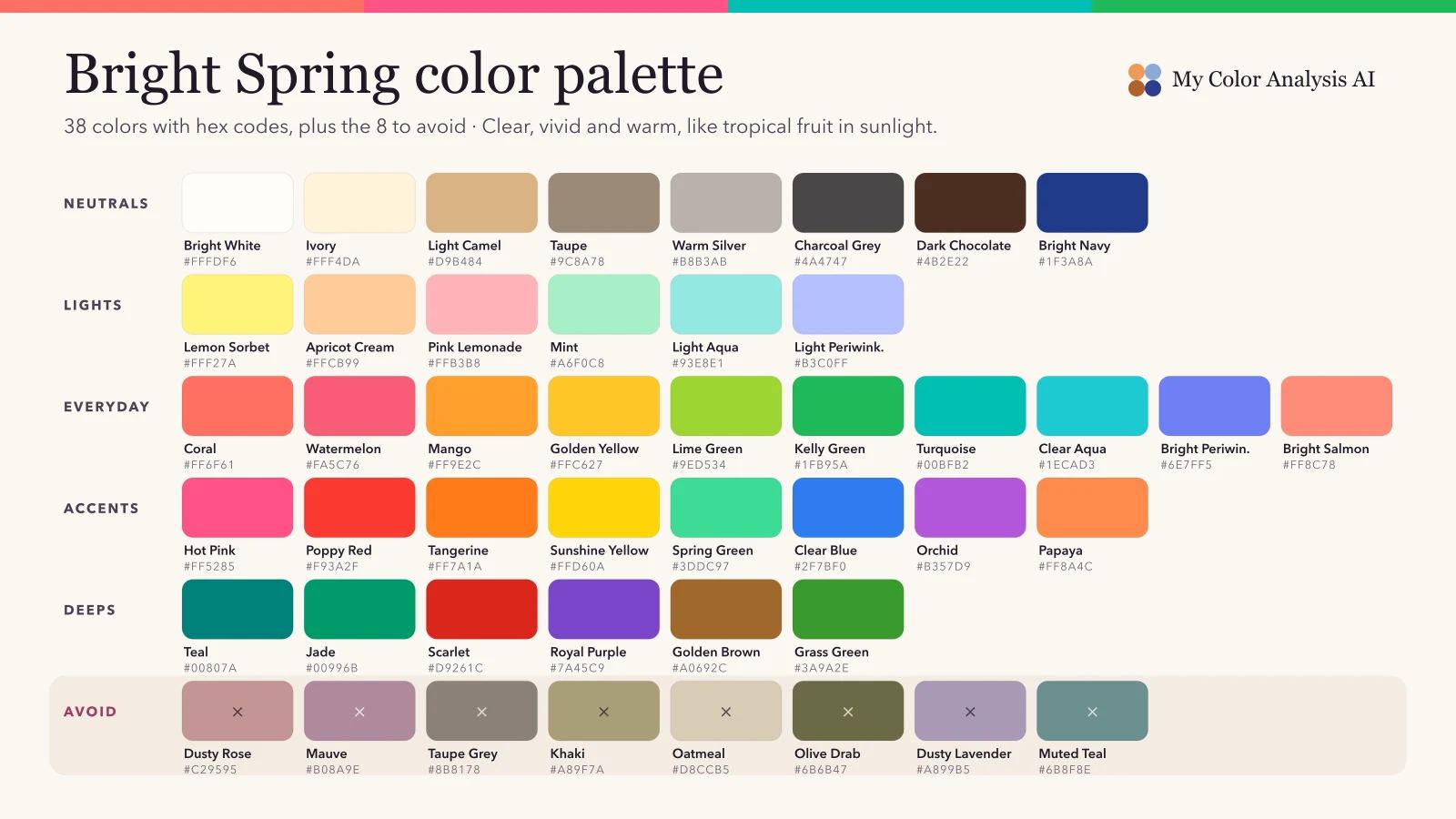
Answer them and you land in one of the 12 seasons, each with its own tested palette. Here's how to do it properly.
How to tell if a color suits you
Before any test, learn what you're looking for. Most people judge the color ("I love this green") instead of their face. Look at your skin and eyes only.
| A color that suits you | A color that doesn't |
|---|---|
| Skin looks even, redness calms down | Redness, blotches or dark circles stand out |
| Shadows around the mouth and nose soften | Shadows deepen, the jaw looks heavier |
| Eyes look clearer and brighter | Eyes look dull or tired |
| You look rested | You look ill, grey, yellow or "made up" |
| People notice you first | People notice the color first |
The effect is subtle on one color and obvious on pairs. That's why every test below compares two colors at a time.
Set up: light, mirror, fabric
You need:
- Daylight. Stand facing a window, no direct sun, all lamps off. Warm bulbs make everyone look like an autumn, and cold LEDs make everyone look like a winter.
- A bare face, hair pulled back or covered with a white towel. Dyed hair influences the result, so cover it if it's far from your natural color.
- Solid fabrics big enough to fill the space under your chin: T-shirts, scarves, towels, even sheets of colored paper in a pinch.
- Your phone. Take a photo of each pair in the same spot. Mirrors adapt to you within seconds; photos don't.
Test 1: are you warm or cool?
Undertone is the color beneath your skin: golden and peachy (warm) or pink and bluish (cool). Hold each pair under your chin:
Warm vs cool pairs
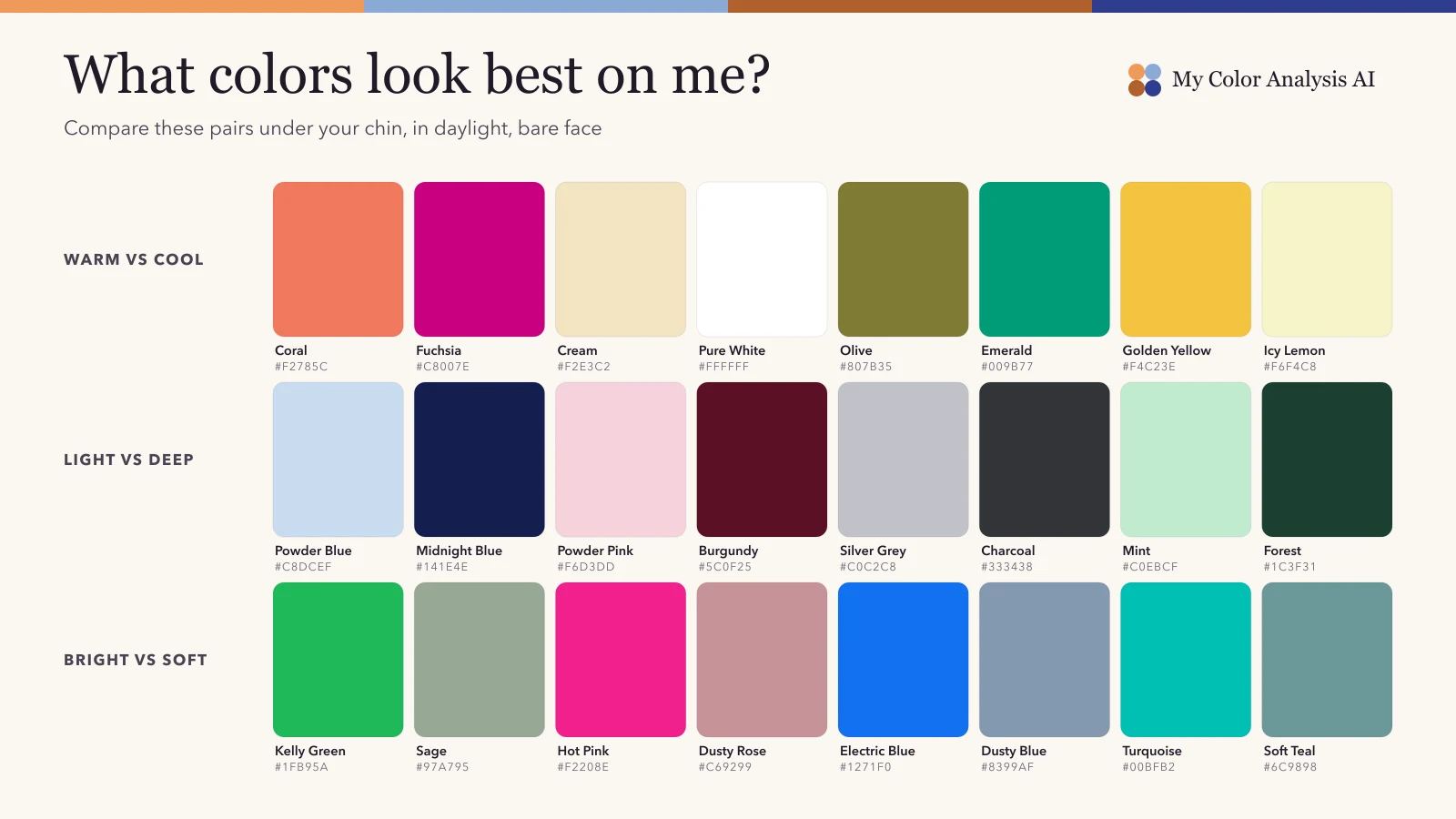
Compare left with right in each pair: coral vs fuchsia, cream vs pure white, olive vs emerald, golden yellow vs icy lemon.
- Coral#F2785C
- Fuchsia#C8007E
- Cream#F2E3C2
- Pure White#FFFFFF
- Olive#807B35
- Emerald#009B77
- Golden Yellow#F4C23E
- Icy Lemon#F6F4C8
Tap a swatch to copy its hex code if you want to match fabrics or paint chips.
- Warm wins if coral, cream, olive and golden yellow make your skin look healthy, while fuchsia and pure white look harsh or make you look pink and blotchy.
- Cool wins if the right-hand colors look clean and bright, while the warm ones make your skin look yellow, orange or sallow.
- Neither wins clearly: you're neutral. That's common, and it usually means your strongest quality is depth or chroma, not temperature.
Gold vs silver jewelry is a good second opinion. Our gold or silver test and undertone test do both on your photo.
Test 2: are you light or deep?
Depth is about how light or dark your overall coloring is: skin, hair and eyes together. Compare the same hue at two depths:
Light vs deep pairs
Powder blue vs midnight blue, powder pink vs burgundy, silver grey vs charcoal, mint vs forest.
- Powder Blue#C8DCEF
- Midnight Blue#141E4E
- Powder Pink#F6D3DD
- Burgundy#5C0F25
- Silver Grey#C0C2C8
- Charcoal#333438
- Mint#C0EBCF
- Forest#1C3F31
- Light wins if the dark colors look heavy, like a block under your face, and the light ones make you glow.
- Deep wins if the light colors look washed out and almost disappear, while the dark ones make your features look sharp.
Your hair is the best clue here. Natural light blonde or light brown almost always means a light or medium season. Very dark hair with pale skin is a contrast question (test 4), not necessarily a deep season.
Test 3: are you bright or soft?
Chroma is the most overlooked quality and the one that explains most "I'm warm but warm colors still look off" frustrations. Compare a clear color with its greyed version:
Bright vs soft pairs
Kelly green vs sage, hot pink vs dusty rose, electric blue vs dusty blue, turquoise vs soft teal.
- Kelly Green#1FB95A
- Sage#97A795
- Hot Pink#F2208E
- Dusty Rose#C69299
- Electric Blue#1271F0
- Dusty Blue#8399AF
- Turquoise#00BFB2
- Soft Teal#6C9898
- Bright wins if the clear colors make your eyes sparkle and the muted ones make you look dull or drab.
- Soft wins if the bright colors look loud, like they arrive before you do, while the soft ones look calm and expensive on you.
Bright people usually have clear, sparkling eyes with a strong white around the iris. Soft people often have eyes with mixed colors (grey-green, soft hazel) and hair without strong shine or highlights.
Test 4: what's your contrast?
Contrast is the difference between your hair, skin and eyes. Take a selfie, convert it to black and white, and look:
- Low contrast: everything reads as similar greys. You look best in colors close to each other in lightness (navy with soft blue, camel with cream).
- Medium contrast: clear difference, but not stark. Most combinations work.
- High contrast: dark hair or eyes against light skin, or very bright eye whites against deep skin. You need some contrast in your outfit too, or you look washed out.
The contrast test measures this from your photo.
Put it together: which season are you?
Your season is decided by your strongest quality, then your second. Use your results:
| Your strongest result | Second | Season |
|---|---|---|
| Light | Warm | Light Spring |
| Light | Cool | Light Summer |
| Deep | Warm | Deep Autumn |
| Deep | Cool | Deep Winter |
| Soft | Cool | Soft Summer |
| Soft | Warm | Soft Autumn |
| Bright | Warm | Bright Spring |
| Bright | Cool | Bright Winter |
| Warm | Bright | True Spring |
| Warm | Soft or rich | True Autumn |
| Cool | Soft | True Summer |
| Cool | Bright, high contrast | True Winter |
Or use the map: pick what you found and see which seasons are left.
Narrow it down from your test results
Pick what you already know about yourself. Leave a row empty if you are unsure.
All 12 seasons
See the colors on your own face
The pairs above work with fabric, but most people don't own 30 solid T-shirts. This does the same thing with your photo. Start with the four True seasons, the purest version of each family: pick one, tap its best colors and its avoid colors, and compare them on your own face. Everything runs in your browser.
Compare 4 seasons on your own photo
True Spring · True Summer · True Autumn · True Winter
Take a selfie or upload one. We put a draping cape on your photo and recolor it with this palette, best colors and the ones to avoid, so you can see the difference on your own face. Your photo stays in your browser.
The most common mistakes
- Testing under indoor light. Warm bulbs push everyone warm. Daylight only.
- Choosing by favorite color. Loving a color doesn't mean it suits you. Keep it for bags, shoes and home.
- Testing with makeup on. Foundation changes your undertone on purpose. Test bare.
- Testing over dyed hair. A copper dye on a cool brunette will pull every test warm. Cover it.
- Judging one color alone. Without a comparison, almost anything looks fine. Pairs reveal the difference.
- Stopping at undertone. Warm vs cool is only one of four answers. Most "it still looks wrong" cases are a depth or chroma problem.
What to do once you know your colors
- Clothes: start with the neutrals in your season (your black, white, navy and beige), then add three or four signature colors. Each season guide has a 10-piece capsule.
- Makeup: match your foundation undertone first, then pick lips from your season. Each guide lists lips, blush, eyeshadow and nails.
- Hair: stay within your temperature. Warm seasons suit golden and copper tones, cool seasons ash and cool browns.
- Jewelry: see our jewelry color guide.
- Anything you already own: the does this color suit me tool checks a garment photo against your season.
FAQ
How do I know what colours suit me?
Compare colors in pairs, in daylight, with a bare face, and look at your skin rather than the fabric. Test warm vs cool, light vs deep and bright vs soft. The combination of your results points to your season.
What colour suits me best?
The colors that match your strongest quality. If you're mainly deep, dark rich colors; if you're mainly soft, muted greyed colors; if you're mainly warm, golden-based colors. Your season's signature colors are the safest starting point.
Is there a color that looks good on everyone?
Not really, but some colors sit in the middle of most dials and fail less often: medium teal, a soft navy and a gentle off-white are low-risk choices when you don't know your season yet.
Can the colors that suit me change?
Your undertone doesn't change, but your hair can grey and a tan shifts how deep you look in summer. Most people stay in the same season or move to a neighbor (often a softer one) as hair lightens with age.
Does the vein test work?
Not reliably. Vein color depends on skin thickness and light. The white vs cream and gold vs silver tests are much better.
Graduated from the ESSEC Business School, Natalie is a marketing expert specializing in beauty tech.